Post - Merger Integration Challenges for Sustainable Growth
How to Navigate Post - Merger Integration Challenges for Sustainable Growth
Post-merger integration represents one of the most complex phases in any M&A transaction. Our experience at Intology shows that over 60 per cent of integration processes fail to meet their strategic objectives due to poor planning and execution. Mastering effective M&A change management and understanding the nuances of buy and build integration and carve-out programme management are essential to secure lasting value from mergers and acquisitions.
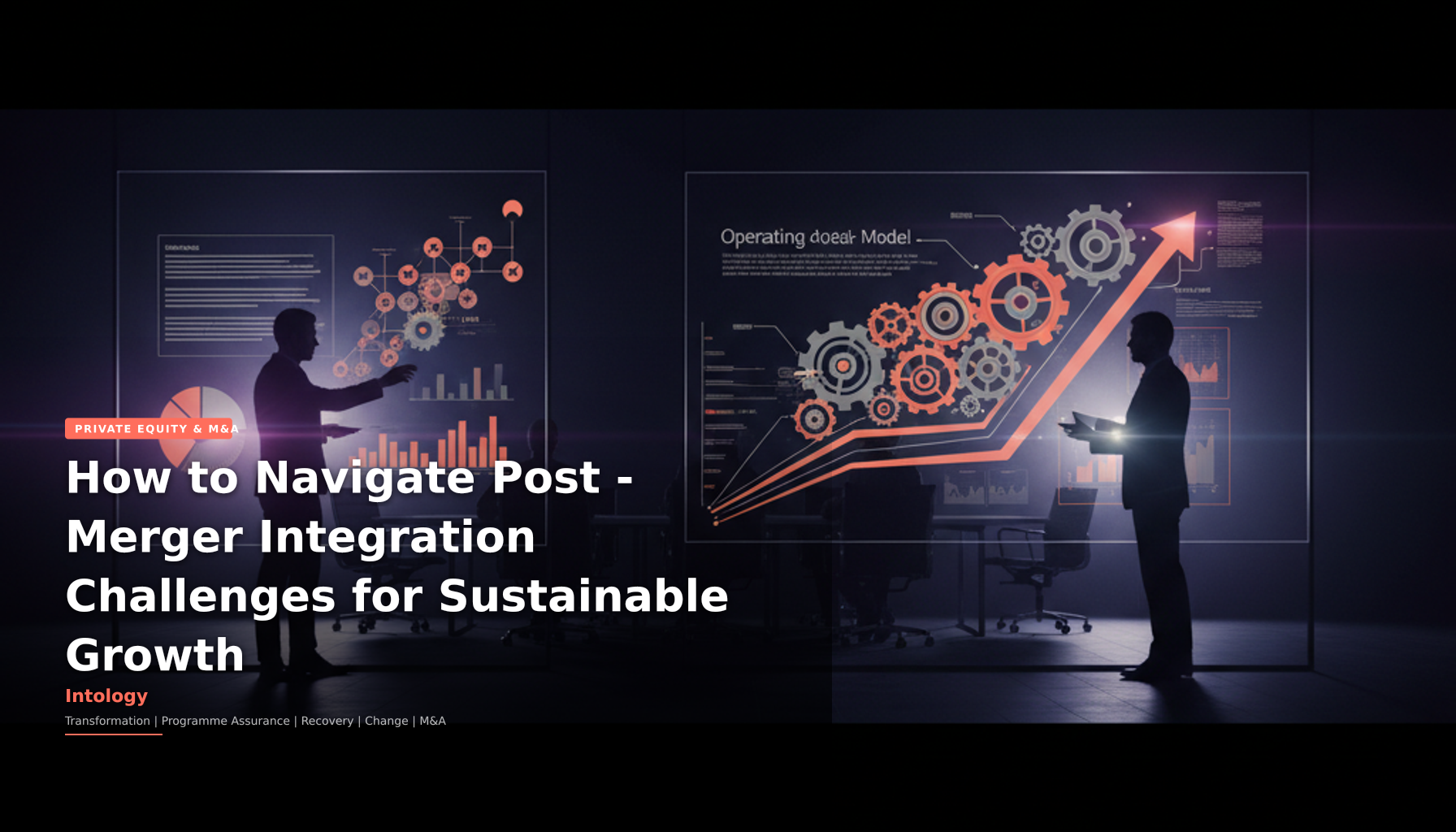
Why Post-Merger Integration Matters
Organisations undertaking mergers or acquisitions aim to unlock synergies, expand market presence, or diversify offerings. However, the integration phase often dictates whether those benefits materialise or evaporate. Without structured post-merger integration, cultural clashes, incompatible systems, duplicated processes, and unclear governance cause value erosion, employee disengagement, and customer attrition. This challenge is especially critical for private equity firms executing buy and build strategies or organisations managing carve-out programmes from divested entities.
Leaders across industries must anticipate and address these integration risks to avoid operational disruption and sustain growth. Inadequate M&A change management during integration undermines stakeholder confidence and jeopardises deal success. Effective integration bridges strategy with execution, aligning technology, people, and processes towards shared objectives.
Key Components of Successful Post-Merger Integration
- Comprehensive Due Diligence to Inform Integration Planning - Detailed assessment of operational, cultural, and technological landscapes prior to deal closure aids in designing a pragmatic integration blueprint. This prevents surprises and identifies critical dependencies early.
- Clear Governance Structure and Decision Rights - Establishing a robust integration management office (IMO) with well-defined roles and escalation pathways ensures accountability and swift issue resolution. Transparency in reporting fosters alignment at executive and programme levels.
- Targeted Change Management for Cultural Alignment - Proactively engaging employees through communication strategies and cultural assimilation initiatives mitigates resistance. Tailored interventions recognise different organisational identities and facilitate cohesive integration.
- Phased Integration Roadmap with Measurable Milestones - Breaking the integration into manageable phases prioritises quick wins while sequencing complex activities logically. Tracking progress against benefits realisation targets supports course correction where necessary.
- Technology Harmonisation and Data Migration Planning - Aligning IT systems while securing data integrity requires early technical evaluation and a dedicated migration plan. This is particularly pivotal in carve-out programme management where separation from legacy systems is needed within tight timelines.
- Continuous Risk Monitoring and Contingency Planning - Identifying integration risks dynamically and preparing fallback options enable resilience against unforeseen challenges such as supplier disruptions or regulatory changes.
Deepening the Analysis: Insights from Buy and Build Integration and Carve-Out Programmes
Buy and build integration is a predominant growth strategy among private equity firms, combining multiple smaller acquisitions into a cohesive platform business. Intology frequently observes that successful execution hinges on harmonising disparate operating models without stifling entrepreneurial agility. Our engagements reveal that the most effective buy and build integration programmes focus on modular integration frameworks: standardising core functions such as finance and HR while allowing business units flexibility to retain local market responsiveness.
Conversely, carve-out programme management entails extracting a business unit or asset from a parent organisation to operate independently or be sold. Here, Intology has seen the greatest pitfalls arise from underestimating the complexity of disentangling shared services, IT infrastructures, and contractual obligations within tight regulatory and financial constraints. Structured integration planning with a distinct carve-out governance team mitigates downstream operational shocks and secures compliance.
Both scenarios demand rigorous M&A change management that adapts to the unique challenges of either consolidating multiple entities or separating sub-divisions. Effective stakeholder engagement coupled with clear, dynamic communication channels has proven pivotal in maintaining momentum and preserving organisational morale throughout these demanding integration journeys.
Common Mistakes to Avoid in Post-Merger Integration
- Neglecting to establish a dedicated integration team with empowered decision-making authority
- Failing to align integration objectives explicitly with overall deal rationale and strategy
- Underestimating the operational and cultural complexity, resulting in overly optimistic timelines and budgets
- Overlooking IT system interdependencies leading to data inconsistencies and downtime
- Insufficient focus on employee engagement, causing resistance and talent attrition
- Ignoring ongoing benefits tracking and post-integration performance measurement
Frequently Asked Questions
What distinguishes buy and build integration from traditional merger integration?
Buy and build integration involves combining several smaller acquisitions into a unified platform, prioritising rapid scale and synergy capture. Unlike traditional mergers, it requires balancing standardisation of back-office functions with preserving the individuality of business units. This approach demands modular integration to retain agility while realising efficiency.
How can carve-out programme management minimise disruption to ongoing operations?
Carve-out programmes require meticulous planning to separate systems, teams, and processes without interrupting core business functions. Establishing a dedicated carve-out governance team, engaging with stakeholders early, and sequencing separation activities carefully enables a smoother transition. Clear communication and contingency planning mitigate risks of operational downtime.
Why is M&A change management critical for post-merger success?
M&A change management addresses the people, culture, and process dimensions of integration that technology and strategy alone cannot solve. It facilitates employee engagement, reduces resistance, and fosters alignment around new organisational goals. Proper change management thus underpins value realisation and sustains performance improvement post-integration.
In summary, navigating post-merger integration challenges requires a disciplined approach combining strategic foresight, robust governance, and meticulous execution. Intology's expertise in managing buy and build integration and carve-out programmes highlights the importance of investing in comprehensive M&A change management to ensure sustainable growth. Organisations that master these complexities will consistently unlock the full potential of their mergers and acquisitions.
How Intology Can Help
Speak To An Independent Consulting Partner
Intology is an independent UK management consultancy specialising in business transformation, programme assurance, recovery, change management and M&A. We help scale-ups, PE-backed businesses and large enterprises deliver complex change with reduced risk and measurable value.